


Xiaomi has often been accused of taking its cues from Apple, but last year the Chinese tech giant started to invite the comparison directly.
Following on from 2024’s Xiaomi 15 Pro, the Xiaomi 17 Pro and 17 Pro Max skipped a year and added a display size to align its numbering and lineup with the iPhone 17 Pro and Pro Max.
The design also shifted to incorporate a camera bump that stretched across the full width of the device — though in Xiaomi’s case, it also housed a full-on OLED display that could be used for notifications or as a camera viewfinder.
The Xiaomi 17 Pro lineup was exclusive to China, so it didn't receive a ton of attention in most of Apple’s major markets. With the 18 Pro, however, Xiaomi is taking the strategy global.
I’ve been using the iPhone 18 Pro since it came out, and the comparison with the Xiaomi 18 Pro is not straightforward.
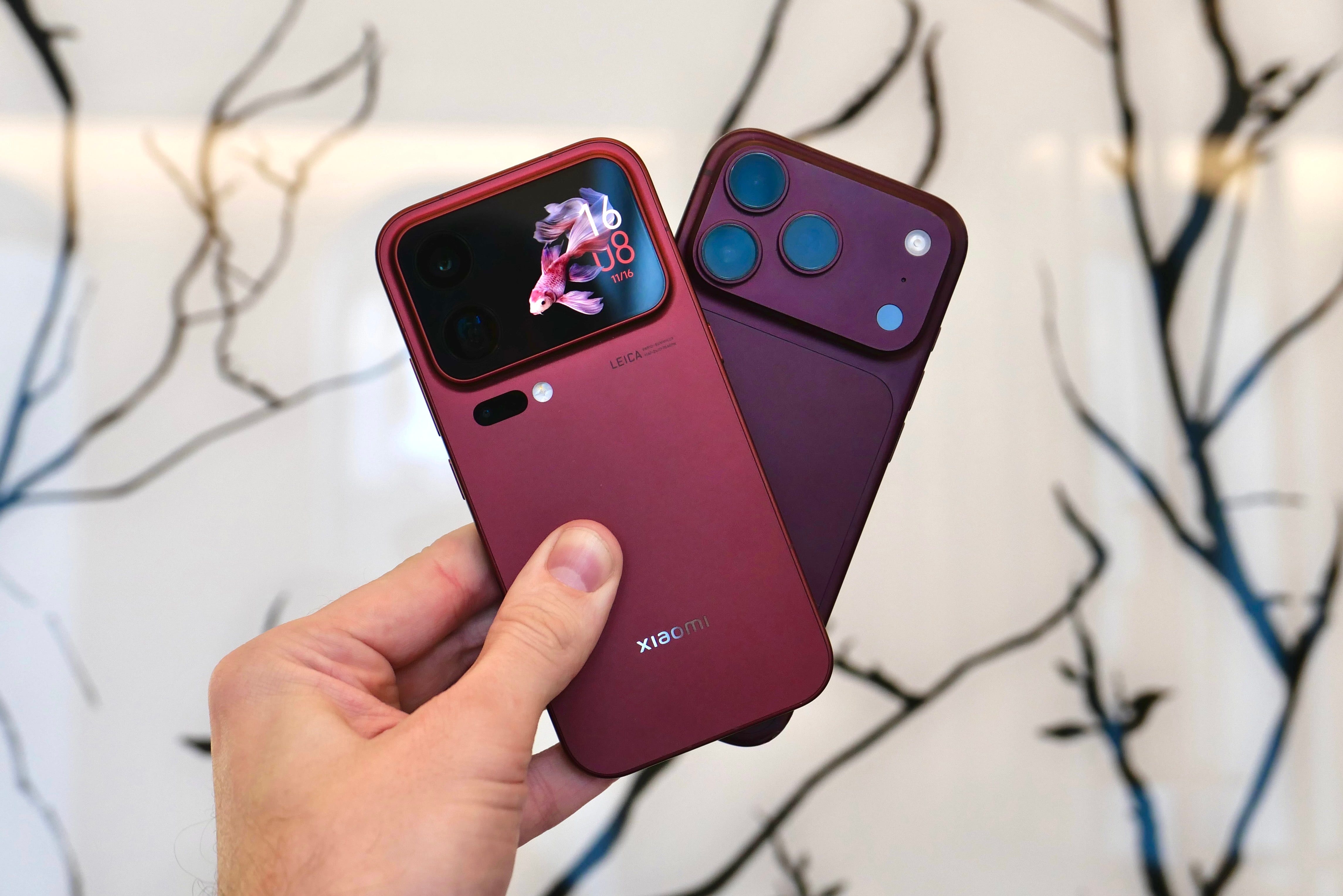
The devices do look similar at a glance. Both phones are 72mm wide. while the Xiaomi is 1.8mm taller and has thinner, 0.9mm bezels that account for its slightly larger 6.4” display next to the 6.3” iPhone. Xiaomi’s phone is 0.3mm thinner at 8.5mm and 13g lighter at 198g.
In practice, they feel pretty much identical in size, but Apple has the advantage in build quality. Xiaomi uses a plastic fiber back panel that comes off as a little cheap compared to the glass on the smaller Xiaomi 17, while the iPhone’s unibody aluminium design with a glass cutout for wireless charging feels more holistically refined.
The biggest difference is when you flip the phones around. Xiaomi’s “Back Display”, a 2.7” OLED panel in the camera bump, can show notifications, music controls and other pinned information when the phone is placed face-down on a flat surface. You can also use Google’s Gemini 4 Argon AI model to vibe-code little apps for the screen by describing what you want in natural language.
It can take a bit of editing to get these right, and functionality is limited by a lack of internet access, but after about 15 minutes I was able to make a pretty good Japanese kanji flashcard app for a specific test I’m studying for. Overall, it’s a fun way to address the situation where few developers are realistically likely to update their apps to make use of the screen.
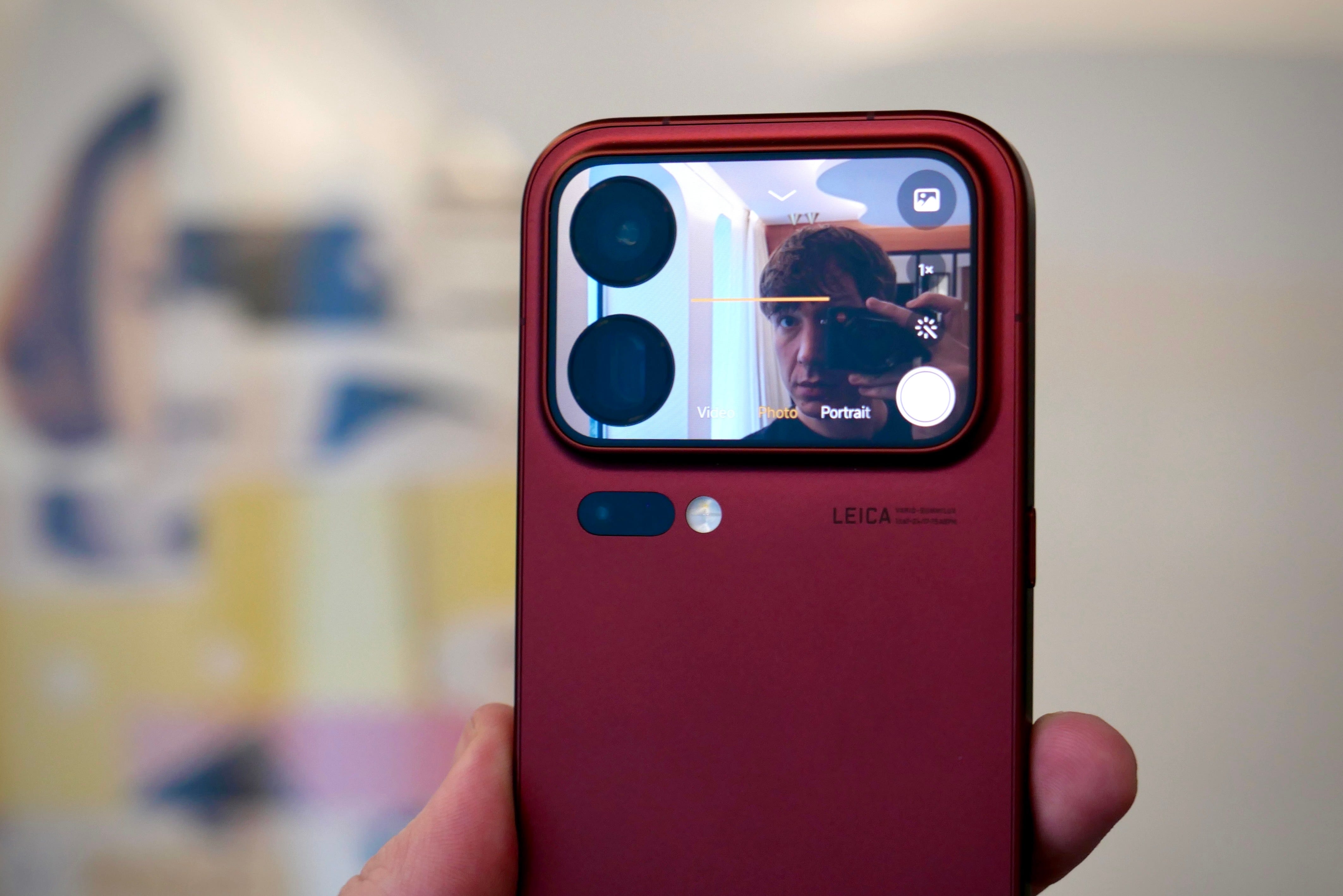
The more obvious use case for the Back Display is as a camera viewfinder, letting you show your subject how you’re framing the shot or use the capable rear cameras for selfies. Apple’s square-sensor selfie camera on the iPhone is a neat trick, allowing you to change the picture’s orientation without rotating the phone, but it obviously can’t compete with Xiaomi’s primary camera system in terms of pure image quality.
Unlike the Xiaomi 17 Pro, the 18 Pro’s cameras are flush with the glass on the second screen, which makes it much easier to swipe from the left to activate the mini camera app.
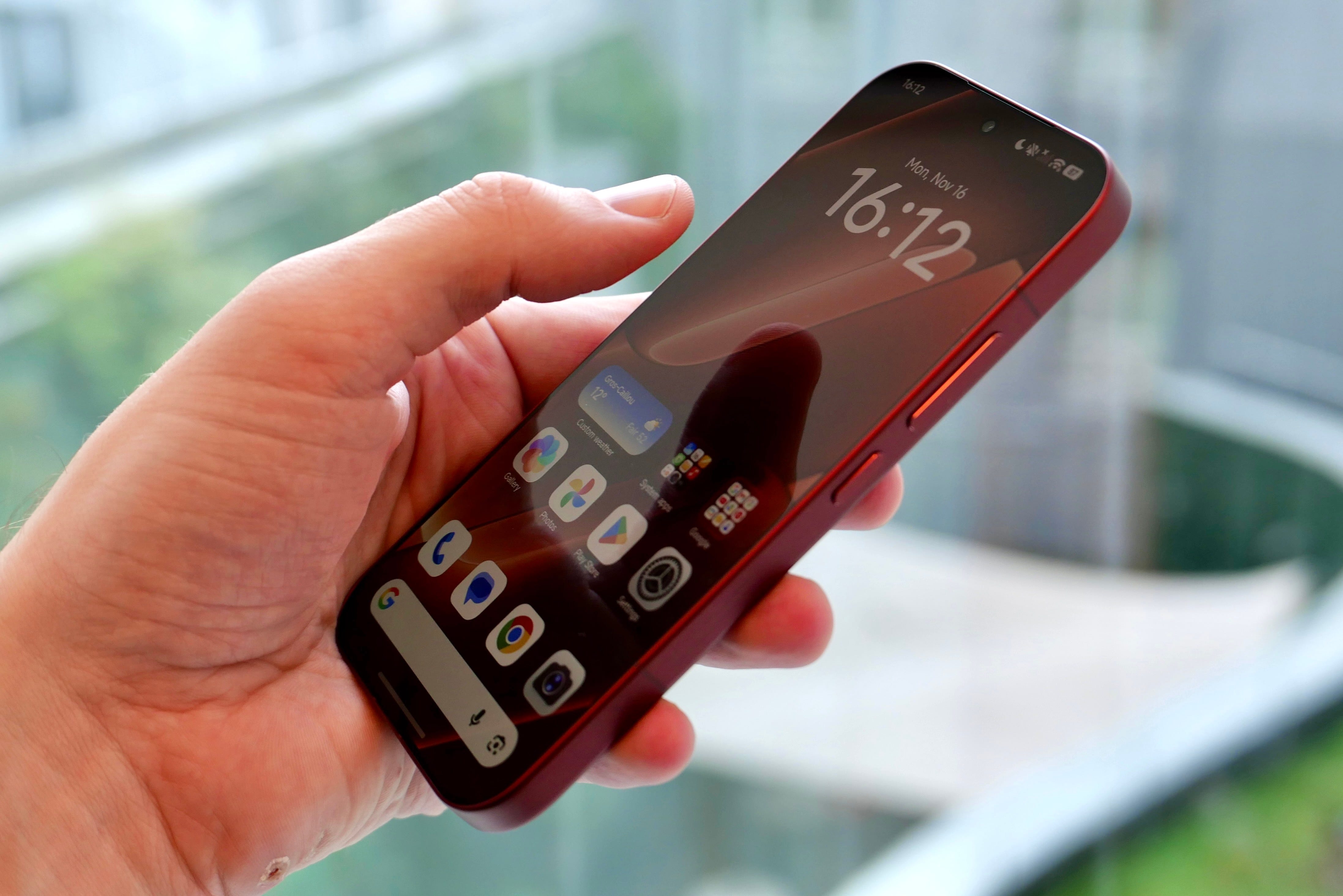
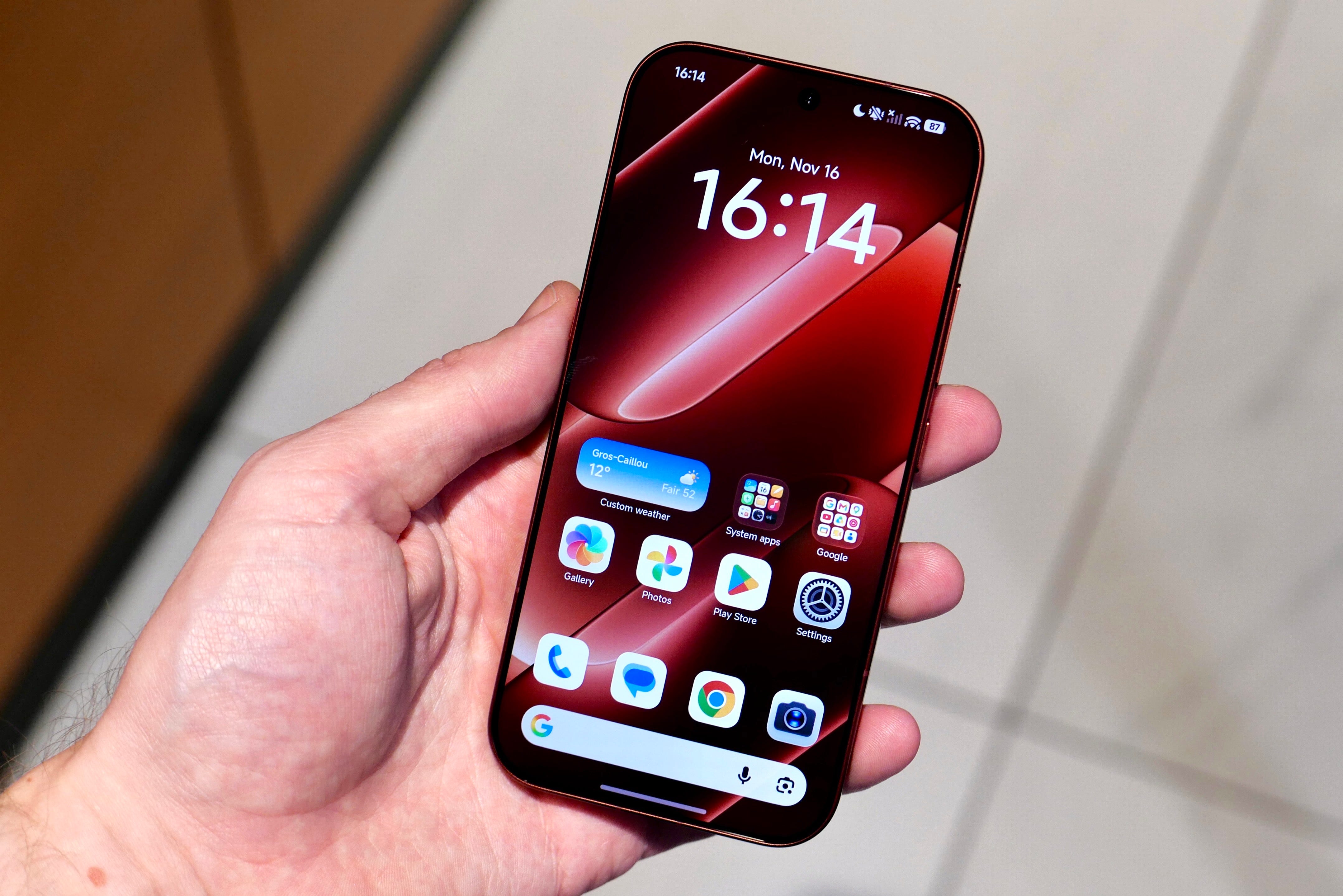
As for the main displays, both phones have 1-120Hz OLED panels of similar sizes. Apple’s resolution is higher, at 2622 × 1206 versus Xiaomi’s 2436 × 1120, but that’s not quite the full story; the custom M11 panel uses what Xiaomi calls HyperRGB 2.0 technology, with a complete RGB subpixel set for every pixel as opposed to the iPhone’s PenTile-style layout.
That means that when it comes to rendering coloured edges and small text, Xiaomi will actually have an advantage in detail. In practice, though, both panels are more than sharp enough for regular use. They also both get very bright; Xiaomi cites a higher peak brightness of 4,000 nits, and side-by-side it does have the edge in sunlight.
You’ll notice a bigger difference is viewing angles. There’s a big loss of brightness on the Xiaomi when viewed from the side, which is a consequence of a privacy feature designed to make the screen impossible for bystanders to read. But it works by altering the pixel structure of half the screen, restricting the angle at which those pixels’ light is visible, and that impacts the display’s viewing angles even when the feature is turned off.
Personally I could live without this feature and would prefer the better viewing angles from the 17 Pro, but others might find it more useful. It can be applied to specific apps, notifications or floating windows, and the RGB subpixel layout does mean Xiaomi’s implementation hurts the display quality much less than Samsung’s similar feature on the Galaxy S27 Ultra, so it could be a valid selling point. It just isn’t really one for me.
The batteries make for a more straightforward comparison, although there is one regional quirk. The global Xiaomi 18 Pro has a 6,000mAh silicon-carbon battery, which is down from the 7,000mAh capacity in the China model; this tends to be a result of the regulatory complexities involved when shipping to various European markets.
That’s still much higher than the 4,288mAh capacity you’ll get with the eSIM-only iPhone 18 Pro I’ve been using, which is the version sold in markets including Japan and the US. The Xiaomi 18 Pro also has a dual-SIM card slot; the iPhone 18 Pro models that do come with a SIM card slot in certain markets have a smaller battery capacity still.
Raw capacity doesn’t translate directly into endurance ratings across different phones or operating systems, of course, and I’ve generally been impressed with the iPhone 18 Pro’s battery life. But it’s worth pointing out that Xiaomi is fitting a meaningfully bigger battery into a thinner and lighter body. Apple still seems inexplicably reluctant to use silicon-carbon technology.
The Xiaomi supports 90W wired fast-charging and 50W wireless charging; both require compatible adapters and cables. Apple is starting to take this feature a little more seriously, citing a 50 percent charge in around 15 minutes using a supported 60W-capable adapter, but the actual charging capabilities are much lower and every Chinese OEM remains well ahead in this regard.
The Xiaomi 18 Pro is the first global phone to support Qualcomm’s latest flagship chip, the 2nm Snapdragon 8 Elite Gen 6; the Pro Max model uses an “Extreme” version with a faster GPU and bigger NPU. Apple, of course, is using its own new A20 Pro.
Both phones have performed excellently, but Apple has the edge in practice when it comes to comparing gaming performance. It’s also noticeable just how little the iPhone 18 Pro heats up even under heavy loads, though the Xiaomi is also well above average in this regard.
Each company is making the most out of their thermal cooling designs and the 2nm architecture of their chips — and Xiaomi is doing it while powering an entire second screen in the area that Apple cleverly uses to house internal components and dissipate much of the excess heat.
The camera system is where Xiaomi has the clearest advantage. As you can see by their size and positioning, Xiaomi is prioritising the main camera and the 3.2x telephoto; the former has a 200-megapixel 1/1.28” sensor, while the latter has a 200-megapixel 1/1.56” sensor with an f/2.4 lens. This is similar hardware to what Oppo is using in the fantastic Find X10 Pro Max.
The Xiaomi 18 Pro Max also uses a more advanced LOFIC primary sensor, which is the same size but offers better HDR performance. I’ve mostly been using the smaller 18 Pro, though, to serve as a direct comparison against the iPhone.
Apple’s main camera has the same size sensor but with a lower 48-megapixel resolution. It has a variable aperture with a faster maximum of f/1.48 compared to the fixed f/1.67 on the Xiaomi, though I find the iPhone defaults to f/1.8 the vast majority of the time for sharpness reasons.
Apple’s 4x telephoto, meanwhile, is far behind Xiaomi’s, with an aging 1/2.55” sensor and an aperture of f/2.8. This is the same hardware found in the 17 Pro and it did represent an upgrade on what came before for Apple, but it was outdated at the time and remains even more so today. Between the aperture and sensor size, Xiaomi’s 18 Pro telephoto takes in 177% as much light as the iPhone’s.
iPhone telephoto shots still have a grainy quality to them with very little depth-of-field separation. Another advantage for the Xiaomi telephoto is its much closer minimum focusing distance, allowing it to serve as a much better macro lens; the iPhone is forced to fall back on its ultrawide.

That said, the iPhone’s ultrawide is better than the Xiaomi’s, as you can perhaps tell from the tiny 50-megapixel component’s positioning on the Xiaomi hardware — almost as an afterthought below the camera bump. Sensor size is not quite as impactful on ultrawide cameras as others, but Apple does hold the slight advantage at 1/2.55" versus 1/2.88", and it also has a noticeably wider field of view at 13mm-equivalence compared to Xiaomi’s 17mm.
All of this is before we get to the question of image processing, where Xiaomi is just plainly superior. The Xiaomi 18 Pro has the same Leica Authentic and Leica Vibrant default modes that you’ll find on all high-end Xiaomi phones from the past few years, and there’s now a new, more neutral “original” style accessible from the same toggle in the main camera app.
Xiaomi has also added another Leica feature called Essential Moment, designed to emulate classic black-and-white film or CCD and CMOS sensors. These modes use an on-device AI model to handle lighting, grain and blur, and the results are very natural. The CCD mode, in particular, is reminiscent of the M9 mode in the Xiaomi 17 Ultra and gives gorgeous warm lighting after sundown.
Apple has taken steps to address its excessively artificial image processing this year, giving users more control over photographic styles and adding some new customisable options, including a film-style mode. That has certainly helped make the iPhone 18 Pro my favourite iPhone to shoot with in quite some time, and it also benefits from an ecosystem of great camera apps, but out of the box there is simply no comparison with Xiaomi’s hardware and Leica’s colour science.


Overall, the Xiaomi 18 Pro confidently goes toe-to-toe with the iPhone 18 Pro, with each phone winning out in certain categories. Xiaomi has the better camera system and offers a unique selling point with the Back Display, but the iPhone has a more refined design and is going to be the obvious option for anyone in the Apple ecosystem.
The two phones are also close from a pricing perspective: the iPhone 18 Pro starts at €1,479 for 256GB of storage and 12GB of RAM in France, where Xiaomi is first launching the 18 Pro, which costs €1,399 for the equivalent model.
Xiaomi clearly isn’t immune to the memory crunch that has affected the tech industry in recent years, and for anyone unfamiliar with the brand, charging close to Apple’s pricing for a phone in a similar category may seem like a stretch.
It’s to Xiaomi’s credit, though, that its own 18 Pro comes out of the comparison more than intact — and depending on your priorities, quite possibly on top.